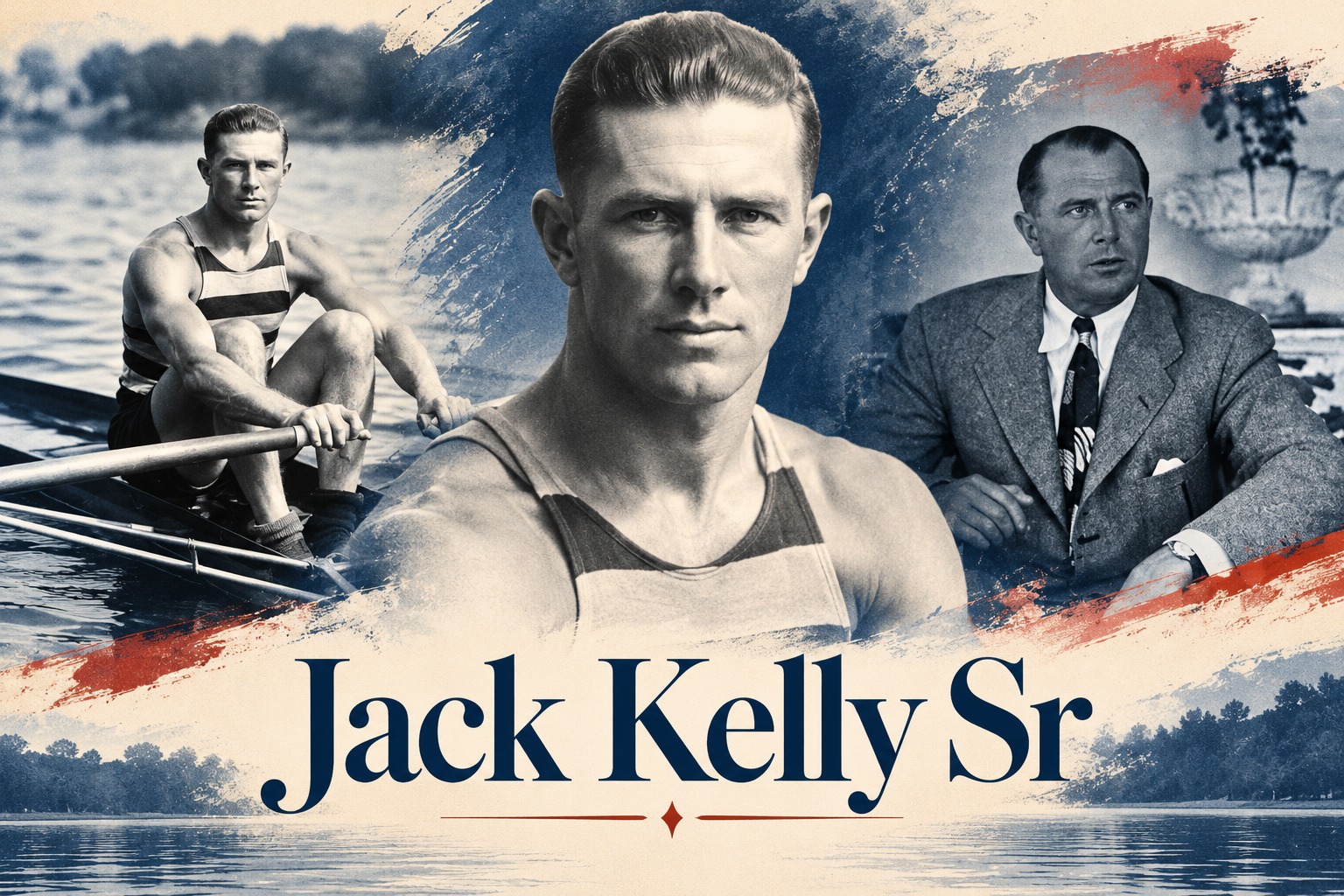
Jack Kelly Sr. built a life that combined Olympic rowing, construction, public service, and a family whose fame eventually crossed the Atlantic. I find the most compelling point in the connection between the work and the sport: a man trained in physical labor became an exceptional competitor on the water. His daughter Grace Kelly would later become a princess, but his own achievements were already substantial before her birth.
Born John Brendan Kelly on October 4, 1889, in Philadelphia, he was the youngest of ten children. His parents, John Henry Kelly and Mary Anne Costello, were Irish immigrants. His father worked in a wool mill. Jack’s early life included mill work and later a bricklaying apprenticeship, placing manual labor at the beginning of a career that would eventually produce considerable business success.
A Trade and a Competitive Temperament
Kelly began apprenticing as a bricklayer in 1907 at his brother Patrick’s firm. He also developed his rowing on the Schuylkill River, with a first race win in 1909. I see the trade and the sport as two parallel disciplines, each demanding repeated effort. The biography does not need to claim that every brick laid directly created an Olympic stroke to recognize that both involved physical work.
He served in the United States Army during World War I, enlisting in 1917 and returning from service in 1919. That same postwar year, he founded John B. Kelly Inc. with a loan from brothers George and Walter. George was a playwright, while Walter was a vaudeville performer. Their help connected his business beginning to a family with achievements beyond athletics.
Three Olympic Gold Medals
At the 1920 Olympics in Antwerp, Kelly won gold in single sculls and double sculls. He added another double sculls gold at the 1924 Paris Games. Those three victories made him a historic figure in American rowing. I place the dates beside the events because they show two gold medals in one Games and a third four years later, rather than three separate Olympic appearances.
His exclusion from the Henley Royal Regatta in 1920 became another defining part of the story. Amateur eligibility rules, including attitudes toward manual occupations, formed the background to the rejection. Kelly then succeeded at the Olympics. The contrast made his athletic reputation larger than a list of medals, linking it with the social barriers surrounding who was allowed to compete.
Building a Construction Business
John B. Kelly Inc. grew into a major construction enterprise, associated with the slogan Kelly for Brickwork. Kelly became a multimillionaire through the business. The firm is the central commercial achievement, built from a trade he had learned as a young man.
His political and civic roles added another dimension. He ran unsuccessfully for Philadelphia mayor in 1935, served as Pennsylvania Secretary of Revenue in 1936 and 1937, and became involved in local Democratic leadership. In 1941, President Franklin Roosevelt appointed him National Physical Fitness Director. His interest in recreation and athletic readiness therefore extended into public responsibilities as well as rowing organizations.
Margaret Majer and Their Four Children
Kelly married Margaret Katherine Majer on January 30, 1924. She came from a German immigrant family and had her own athletic background, including coaching women’s sports at the University of Pennsylvania. I regard Margaret as more than the spouse of a champion. Athletic accomplishment existed on both sides of the marriage that formed the Kelly household.
Their children were Margaret, known as Peggy, born in 1925; John Brendan Kelly Jr., born in 1927; Grace Patricia Kelly, born in 1929; and Elizabeth Anne, known as Lizanne, born in 1933. The family established a home in Philadelphia’s East Falls neighborhood. The children followed different adult paths, with Jack Jr.’s sport and Grace’s acting bringing particularly broad public attention.
Jack Jr. and Grace
Jack Kelly Jr., also called Kell, became an Olympic rower in his own right. He competed in four Olympics between 1948 and 1960 and won a single sculls bronze medal in 1956. He also won the Henley Diamond Sculls in 1947 and 1949. I find the Henley victories a striking second generation detail after his father’s exclusion, while keeping their separate competitive records clear.
Grace became an Academy Award winning actress, receiving the Best Actress award for The Country Girl. In 1956, she married Prince Rainier III of Monaco and became Princess Grace. Her children, Caroline, Albert, and Stéphanie, were Jack Sr.’s grandchildren. The royal connection came through Grace’s marriage; it was not the starting point of Jack’s own public life.
A Family Remembered Across Decades
Other grandchildren include John B. Kelly III through Jack Jr. The broader family also includes descendants of Peggy and Lizanne, but uncertain parentage should not be assigned from a name alone. I see the older family connections as equally important: Patrick in construction, George in playwriting, and Walter in vaudeville show the range of achievement among Jack’s brothers.
Jack died in Philadelphia on June 20, 1960, at age 70. His later honors included recognition in rowing, Olympic, and Philadelphia sports halls of fame. Grace’s death in 1982 and Jack Jr.’s death in 1985 occurred after him. They form part of the later Kelly family story, rather than losses Jack Sr. personally lived through.
FAQ
How many Olympic gold medals did Jack Kelly Sr. win?
He won three. Two came in Antwerp in 1920, in single sculls and double sculls. The third came in double sculls at the 1924 Paris Olympics. I distinguish those gold medals from the bronze won by his son Jack Jr. in 1956.
Was Jack Kelly Sr. Grace Kelly’s father?
Yes. Grace was one of Jack and Margaret Majer Kelly’s four children. Her siblings were Peggy, Jack Jr., and Lizanne. Grace’s later marriage to Prince Rainier made Jack the grandfather of Caroline, Albert, and Stéphanie of Monaco.
What business did he build?
Kelly founded John B. Kelly Inc. in 1919 after working as a bricklayer. The construction business grew substantially and made him wealthy. It was separate from his athletic career, although both remained central to his public identity in Philadelphia and beyond.